
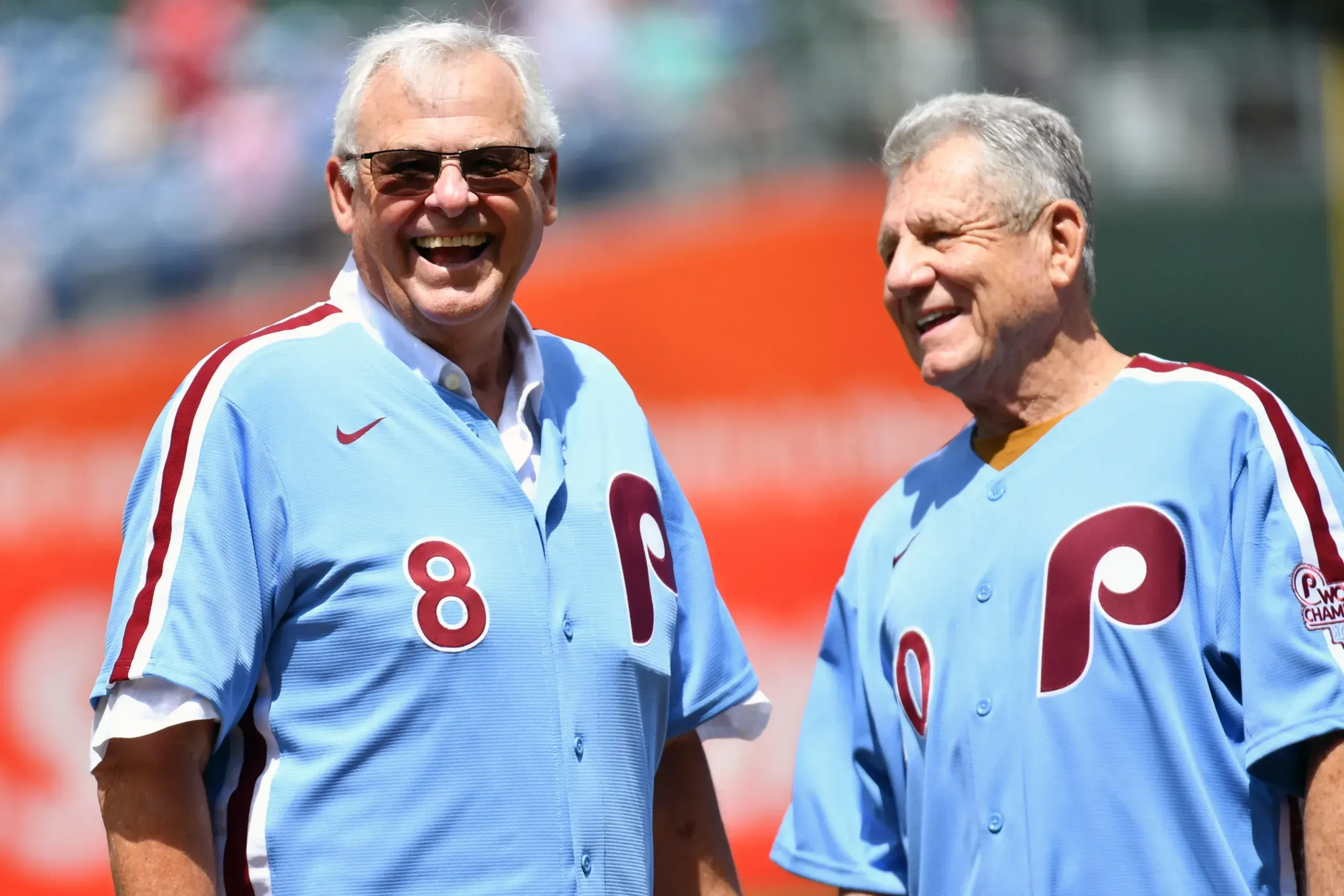
Bob Boone, the steady, durable catcher who became one of the defining players of a golden era in Phillies history and helped deliver the franchise’s first World Series championship in 1980, died Monday. He was 78.
A Phillies Wall of Famer, Boone was a part of a three-generation family in baseball, and spent 10 of his 19 years behind the plate catching for the Phillies.
Despite seven seasons with the California Angels and his final two with the Kansas City Royals, Boone will forever be remembered in red pinstripes, crouched behind home plate at Veterans Stadium during a period when the franchise transformed from perennial disappointment into a National League power.
Boone debuted in 1972 and remained with the Phillies through 1981. He was an integral part of the clubs that won three consecutive National League East titles from 1976 through 1978, then helped finish the job two years later when Philadelphia finally broke through and won the World Series. The team also qualified for the playoffs with Boone behind the plate in the players’ strike-shortened 1981 season, but lost to the Montreal Expos in the five-game Division Series, which was concocted by the league to pit the team with the best record in the first half of the season (before the strike) against the team with the best record int he second half against one another.
Boone was not the loudest personality on those teams. He did not hit like Mike Schmidt or Greg Luzinski, nor did he command the spotlight the way Steve Carlton could from the mound.
Boone’s value was found elsewhere.
He was dependable. He was intelligent. He was durable. And behind the plate, he was among the best defensive catchers of his generation. Yeah, there was a guy named Johnny Bench in Cincinnati at the time, but Boone still found a way to win two Gold Gloves – the first Phillies catcher to do so – and make three All-Star games as a Phillie. He added five additional Gold Gloves and another All-Star appearance with the Angels.
Originally drafted by the Phillies in the sixth round in 1969 out of Stanford as a third baseman, Boone was converted to catcher in the minor leagues. The move changed the course of his career and eventually placed him among the most accomplished defensive backstops in baseball history.
His best offensive season for the Phillies came in 1978 when he slashed .283/.347/.425 for a .772 OPS. He finished with a career-high 12 homers and had 62 RBIs. His OPS+ was 115, also a career-high, as was his 3.6 WAR.
But it was in October 1980 that Boone’s name became permanently attached to Philadelphia baseball history.
During the deciding Game 5 of the National League Championship Series against Houston, Boone delivered a two-run single off Nolan Ryan as the Phillies fought through one of the most dramatic playoff series in franchise history. Later in that same game, his infield hit helped ignite the five-run eighth-inning rally that brought Philadelphia back from a 5-2 deficit and eventually sent the Phillies to the World Series.
Against Kansas City in the World Series, Boone was even better.
Known primarily for his glove, he led the Phillies with a .412 batting average in the six-game series and drove in four runs as Philadelphia captured the first championship in franchise history.
And when Tug McGraw struck out Willie Wilson for the final out of Game 6 at Veterans Stadium, Boone was behind the plate.
The image is inseparable from Phillies lore: McGraw leaping off the mound, arms raised, while Boone emerged from behind the plate as Philadelphia celebrated something it had waited nearly a century to experience.
Of course, it followed one of the most memorable plays in World Series history, when a Frank White pop-up bounced out of his glove and into the glove of first baseman Pete Rose for the second out of the ninth inning.
Boone’s Phillies tenure ended after the 1981 season, when he headed to the American League.
By the time he was finished, Boone had caught 2,225 games, still the third-most in major league history.
His final career numbers included a .254 batting average, 1,838 hits, 105 home runs and 826 RBIs.
Baseball, however, was never merely Boone’s profession. It was the family trade.
His father, Ray Boone, was a two-time All-Star who played 13 major league seasons. Bob’s sons Bret and Aaron both reached the majors, making the Boones baseball’s first three-generation major league family. Bret became a three-time All-Star, while Aaron played 12 seasons and later became manager of the New York Yankees.
After his playing career, Bob Boone remained deeply involved in the game. He managed the Kansas City Royals and Cincinnati Reds and later worked in the Washington Nationals’ front office, including as assistant general manager and vice president of player development.
The Phillies inducted Boone into their Wall of Fame in 2005, officially recognizing a career that had already secured its place in the franchise’s history.
For a generation of Phillies fans, Boone represented something larger than statistics.
He was part of the group that changed what was possible in Philadelphia baseball.
Before Boone, Schmidt, Carlton, Larry Bowa, Luzinski, McGraw and their teammates, the Phillies were a franchise defined largely by frustration. By the time that group finished, a championship banner finally flew atop Veterans Stadium, and now flies in the outfield at Citizens Bank Park.
