
Beth Ann Rosica’s writings are a blend of news, opinion, and analysis.
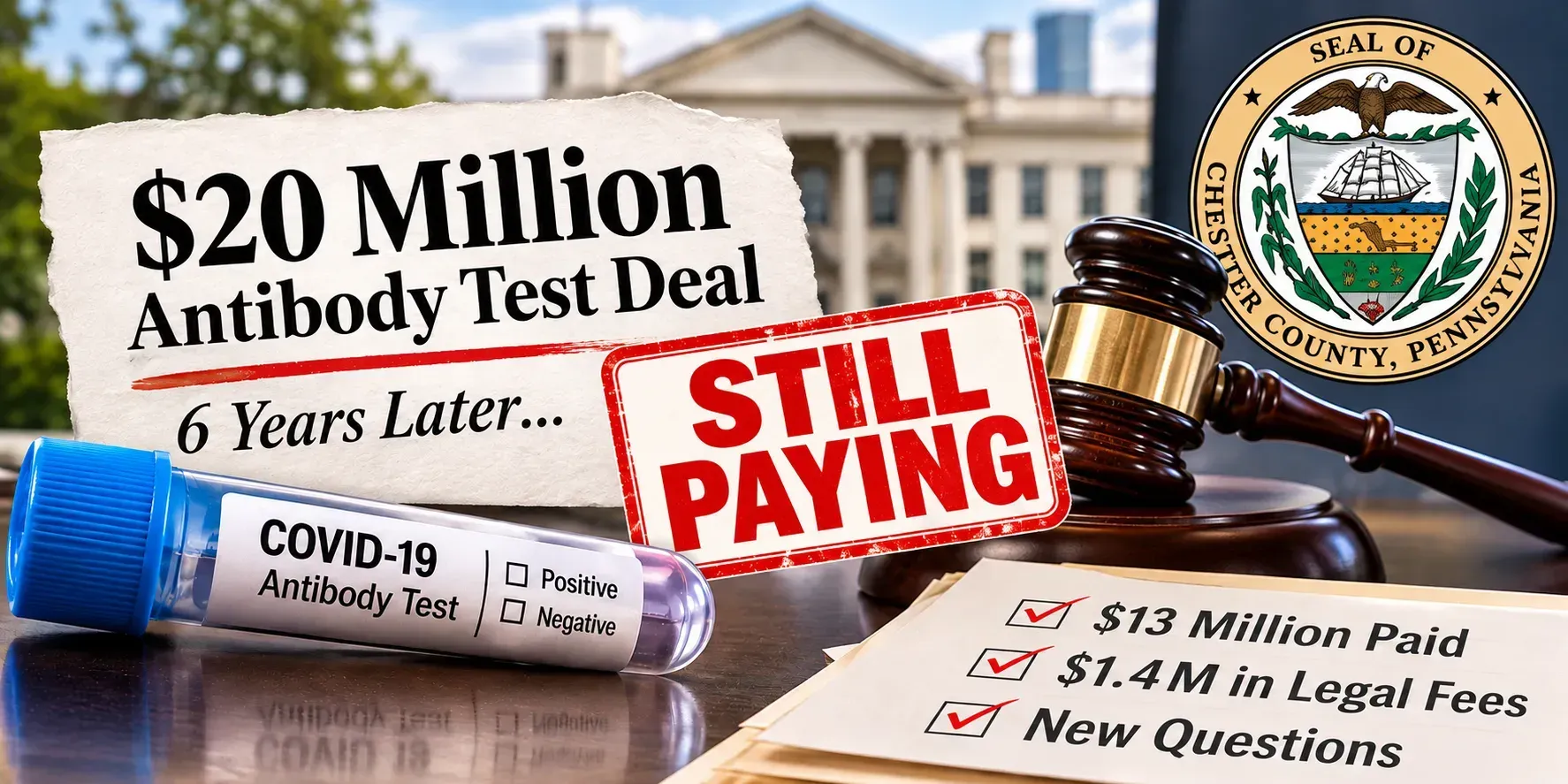
Six years after Chester County committed $20 million to a Covid antibody test deal that went terribly wrong, taxpayers are still footing the bill.
Before halting scheduled payments on the full $20 million contract, the county paid Advaite Inc. $13 million for one million antibody tests but received just 92,325. The resulting lawsuit, filed in 2021, has already cost taxpayers nearly $1.4 million in legal fees through April 2026.
And the legal troubles aren’t over. The county hired two different law firms to handle the case, one with a 25 percent contingency agreement, only to have that firm disqualified this year after hiring an attorney who had previously represented the opposing side in the very same dispute.
Advaite’s attorneys argued the first law firm hired, Anapol Weiss, should be disqualified from representing Chester County because one of its assigned attorneys, Ashley Garland, previously worked for Mitts Law, LLC and represented Advaite in this specific dispute.
Judge Cheryl L. Austin, assigned to the Chester County Court of Common Pleas case, sided with Advaite’s attorneys. In her April 17, 2026, ruling, she disqualified Anapol Weiss over the firm’s failure to comply with the screening and notice requirements of the Rules of Professional Conduct. Co-counsel Pietragallo Gordon Alfano Bosick & Raspanti, LLP, she noted, was “quite capable of continuing Plaintiff’s representation.”

This latest ruling is yet another example of the county’s poor judgment that ultimately costs taxpayers.
Chester County was one of the most restrictive counties in the state during the Covid lockdowns. Its decision to purchase a million Covid antibody tests — unproven technology — was questionable at the time and even more concerning in hindsight.
It gets worse.
If not for a local citizen digging into the purchase through Right to Know requests and general inquiries, the county may never have realized that there was a problem.
Whether the county knew about the default prior to the inquiries is unknown, but a year later in 2021, the county filed suit against both Advaite and its co-founder and CEO, Karthik Musunuri.
The Chester County Commissioners signed an initial engagement letter with Anapol Weiss on January 21, 2021; however it was dated December 18, 2020, with a caveat that it was contingent upon the commissioners vote and signature.
The complaint was filed by Anapol Weiss on January 15, 2021, in the Chester County Court of Common Pleas and alleged breach of contract, unjust enrichment, and negligent misrepresentation. The county requested approximately $12 million in damages to compensate for $13 million in expenses for tests it never received.
The initial engagement letter with Anapol Weiss makes reference to a contingency fee but does not include any details about the percentage or other billing rates. (The entire first section is redacted so it is possible the rates are included in the redactions.)
Just a few months later, Chester County added a second law firm to the litigation, approving a March 11, 2021, contract with Pietragallo Gordon Alfano Bosick & Raspanti, LLP for “additional Legal Services as required by the County Solicitor’s Office.” Why the County believed additional counsel was necessary remains unclear.
A little over four years later in June 2025, the county processed an addendum with Anapol Weiss changing the compensation from the original contingency arrangement to a combination of hourly billing and a 25 percent contingency fee, with hourly payments credited against any eventual recovery. It also allows the County to terminate the agreement with ten days’ written notice and requires payment for work completed. Unlike the original agreement, the amendment does not expressly protect the firm’s contingency fee if the County terminates its representation.
From March 2021 through April 2026, the county paid Pietragallo Gordon Alfano Bosick & Raspanti, LLP $1.2 million in legal fees related to the Advaite case.
On March 25, 2026, Anapol Weiss submitted its first invoices totalling $185,361.60, and according to a Right to Know request, these are the firm’s only invoices through April 2026.
Less than a month after Anapol Weiss submitted its only invoice thus far, the judge issued the disqualification order.
Pennsylvania Rule of Professional Conduct 1.10(b) addresses conflicts of interest when an attorney joins a new law firm after representing an opposing client in the same or a substantially related matter. The rule requires the new firm to screen the attorney from any participation in the case, ensure the attorney receives no portion of the fee, and promptly provide written notice to the appropriate client.
Attorney Garland previously worked for Mitts Law, LCC, the same firm that represents Advaite. In order for Anapol Weiss to represent Chester County, according to the Rule of Professional Conduct, it was required to keep Garland “screened from participation in the matter” and to provide written notice “promptly” to the appropriate client.
Judge Austin found that neither Anapol Weiss nor Garland provided the required notice to Mitts Law, LLC, in violation of Pennsylvania Rule of Professional Conduct 1.10(b).
Following the firm’s disqualification, the County has not confirmed that it formally terminated the agreement, according to its response to a Right to Know request and publicly available records.

Because the County has not confirmed that it formally terminated the agreement, it remains unclear whether Anapol Weiss retains any entitlement to the 25 percent contingency fee. Neither the original agreement nor the 2025 amendment expressly addresses compensation following judicial disqualification.
If the County recovers the approximately $12 million sought in its lawsuit and the 25 percent contingency provision applies, Anapol Weiss could potentially be entitled to as much as $3 million.
Now, the million dollar question (or more aptly, the three million dollar question) is whether Anapol Weiss remains entitled to the 25 percent contingency fee.
The litigation has experienced significant delays. The original trial date was scheduled for May 15, 2026. Following the removal of Anapol Weiss, a new date was set for November 16, 2026, however that was also postponed. Currently, there is not a trial date on the docket.
The costs of these delays fall on taxpayers and raise additional questions about the County’s handling of the litigation.
- Who recommended hiring Anapol Weiss with a 25 percent contingency fee and what due diligence did the County conduct before approving the arrangement?
- When did Anapol Weiss discover Garland’s prior involvement and when did they notify the County?
- Why did the County believe a second law firm was necessary when it already had experienced counsel representing it?
- Did the County ever officially terminate the agreement with Anapol Weiss following the disqualification order, and if no, why not?
While Chester County residents are entitled to answers, none are forthcoming.
Chester County Communications Director Andrew Kreider replied to a request for comment, “As a matter of policy, Chester County does not comment on pending or ongoing litigation.”
Anapol Weiss did not return a request for comment.
Six years after Chester County committed $20 million to a questionable Covid antibody test purchase, taxpayers are still paying the price through mounting legal fees, trial delays, and the potential for an additional $3 million contingency fee. The County has yet to recover the money paid for tests it never received, and its handling of the litigation has only added to the questions surrounding the initial deal.
The original purchase was a costly mistake. The subsequent legal decisions raise questions about whether anyone learned from it.
